07 · Research · Robotics
Bio-inspired fiddler crab robot
A robotic claw that replicated the mating wave of a male fiddler crab for field work in Thailand.
I translated observed fiddler crab behavior into a compact robotic system: hardware selection, embedded software, motion planning, CAD, prototyping, and field-ready integration.
Preserving the character of the wave
Turning a mating display into a machine meant preserving the character of the wave, not just the geometry. I broke observed movement into engineering requirements, then tuned the timing and amplitude until the gesture read correctly in the field.
A compact field-ready mechanism
The claw used a 2-DOF servo-actuated mechanism, custom 3D-printed parts, and an Arduino Nano controller. Python tools handled real-time motion tuning and data capture, so the wave could be adjusted between takes rather than between builds.
A custom tool for shaping the claw's path
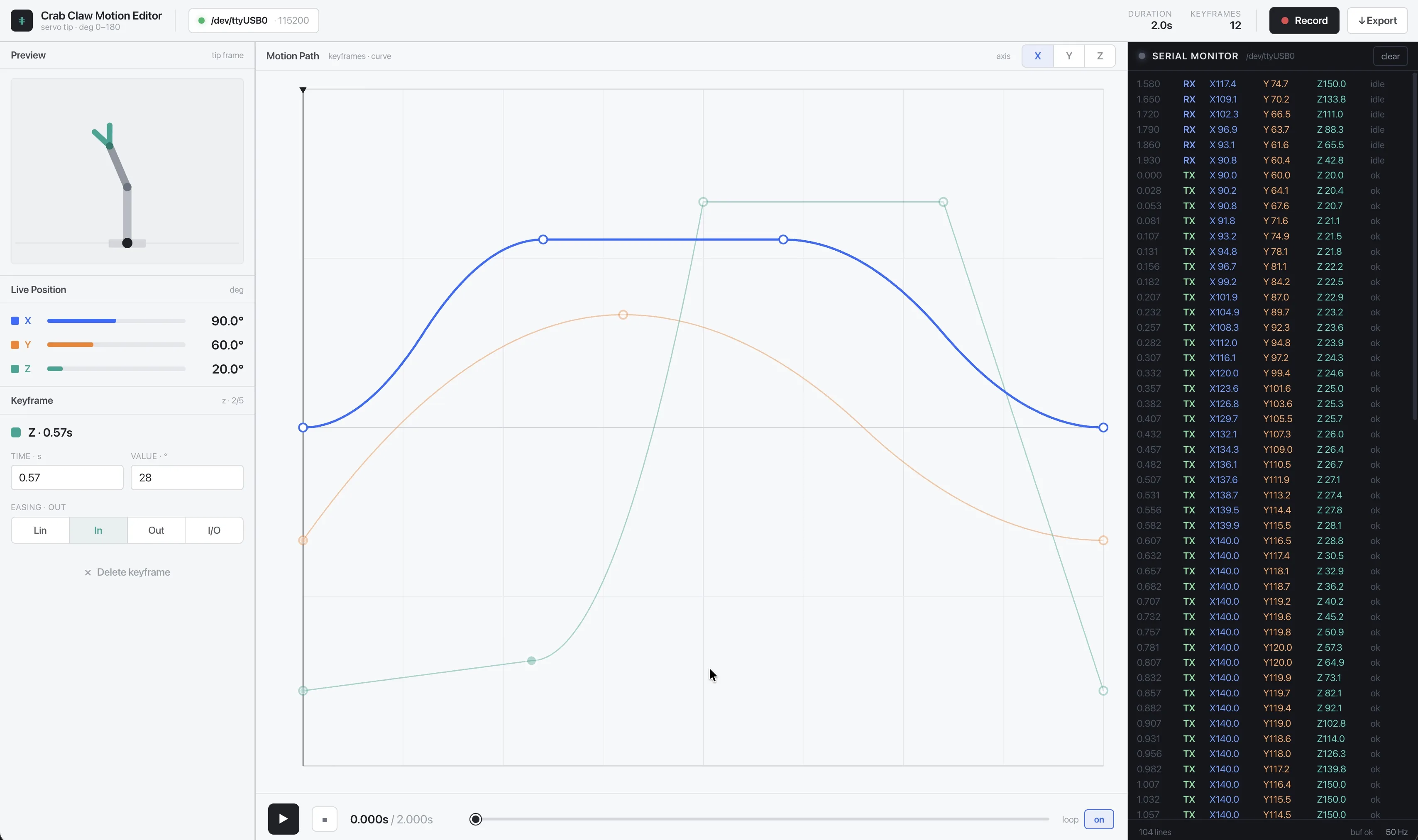
To get the wave right I built a custom tool for authoring the claw's motion path directly. It let me tweak keyframes, timing, and easing for each servo and preview the resulting trajectory, then push the refined path to the controller — so refining the gesture was a matter of adjusting curves rather than reflashing hand-edited values.
Designed for work outside the lab
The system was built for an international science and wildlife media production in Thailand, where reliability, portability, and fast iteration mattered as much as mechanical fidelity.